
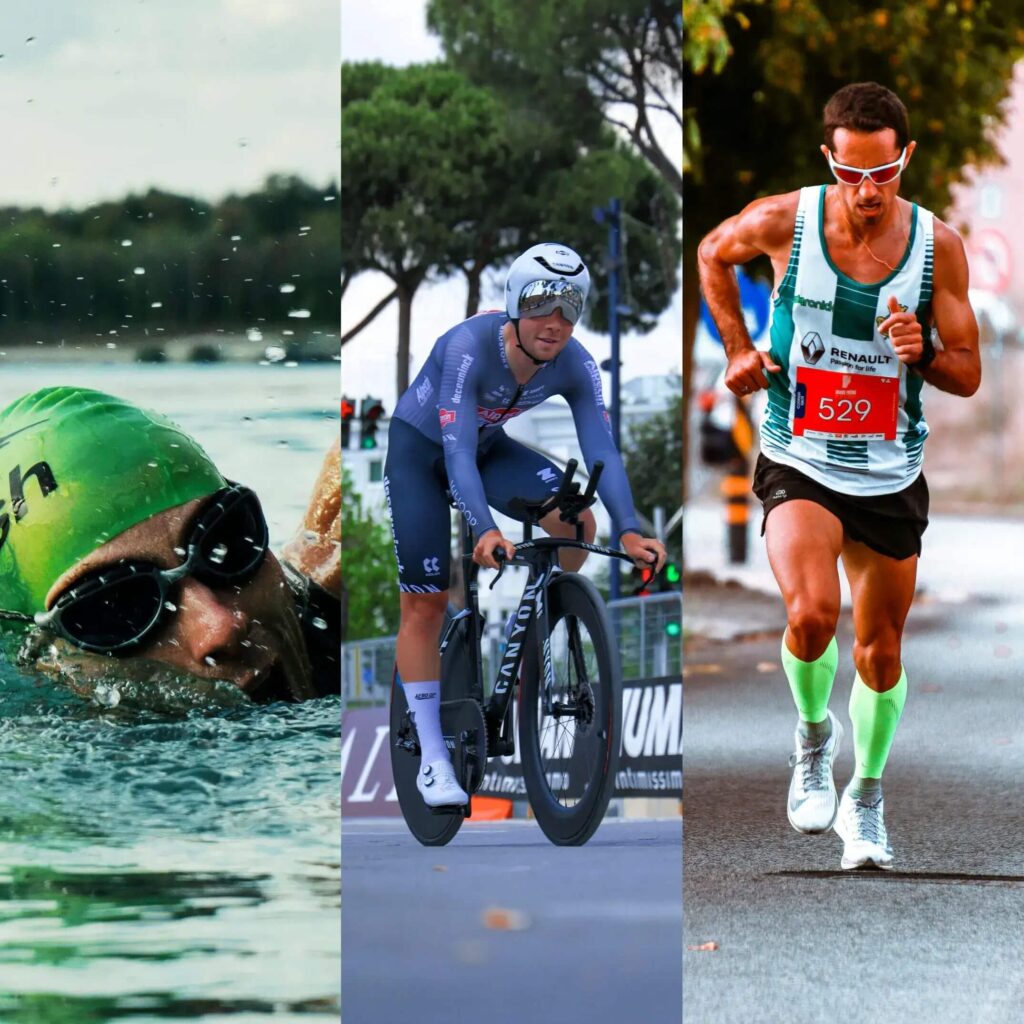
Your fastest swim means little if you miss the buoy.
You can hold a steady pool pace and still struggle to navigate an open-water course. Each time you lift your head too far, you can drop your hips, interrupt your pull, and kick harder to regain your position. If you avoid looking altogether, you risk swimming farther than you need to.
You need a sighting action you can repeat without rebuilding your stroke afterward. This progression helps you practise that skill in the pool, then adapt it to the water you actually race in.
Separate your sight from your breath
Start by treating sighting as a quick visual check, not a forward-facing breath. In calm water, lift only enough to bring your eyes above the surface. Keep your mouth in the water, then turn to your usual breathing side as your stroke continues.
Think: eyes forward, turn to breathe, face down.
Let your lead arm support the front of your stroke briefly, but avoid pressing it straight down to lever your head upward. Keep your kick compact rather than adding a wide scissor kick. If you need a large kick every time you look, reduce the height and duration of your head lift.
You may need more clearance in chop. Practise the low version first so you have a controlled starting point rather than an exaggerated lift you must later undo.
Choose a target before you push off
Choose a clear, stationary object beyond the end of your lane: a clock, a sign, or a distinctive tile above the waterline. Keep your normal lane awareness and avoid staring forward as you approach the wall.
Your job involves identifying the target, not merely lifting your goggles. After each repetition, ask yourself whether you actually saw it. A head lift without useful visual information adds disruption without helping you navigate.
Build the skill in three steps
1. Rehearse one look at a time
Swim 4 × 50 easy, with 15–20 seconds of rest. During each length, take one deliberate sighting look near the middle of the pool, away from either wall. Swim normally before and after it.
Focus on returning your face smoothly to the water. If you stall, shorten the look rather than pulling harder to compensate. You should finish each repetition feeling that you inserted a small action into your freestyle, not switched to a different stroke.
2. Repeat the look without chasing speed
Next, swim 6 × 50 with 15–20 seconds of rest. On the first 25, sight every six to eight arm strokes; count each hand entry as one stroke. Swim the second 25 normally.
Use that interval as a practice constraint, not a universal race rule. Keep your breathing comfortable between looks, and continue exhaling into the water. If the sequence makes you hold your breath or rush your inhalation, slow down and take fewer looks.
3. Hold the skill across longer repetitions
Swim 6 × 100 at a controlled endurance effort, resting 20 seconds between repetitions. Alternate a normal 100 with a sighting 100. On each sighting repetition, use your six-to-eight-stroke practice interval.
Compare your time, effort, and rhythm across the two versions. You do not need identical splits. You want a repeatable sighting action without a pronounced pause, a frantic catch-up effort, or growing breathlessness.
If you already use training paces, your results from Find Your Swim Training Pace With a 400/200 Test can help you choose a sensible endurance effort. Treat that pace as a guide here, not a target you must force through deteriorating technique.
Your complete 1,500-metre sighting session
- 300 metres easy: Settle into comfortable freestyle.
- 4 × 50 rehearsal: Take one look per length; rest 15–20 seconds.
- 6 × 50 integration: Practise repeated sighting on the first 25, then swim normally; rest 15–20 seconds.
- 6 × 100 endurance: Alternate normal and sighting repetitions; rest 20 seconds.
- 100 metres easy: Finish with relaxed swimming.
For a shorter version, reduce the endurance block to 4 × 100. You will swim 1,300 metres while keeping the full skill progression. In a yard pool, follow the same distances in yards.
Adapt your sighting to the course
Once you reach open water, adjust how often you look. You may need frequent checks near turns, through chop, or whenever you lose confidence in your direction. On a clear, straight section, you can experiment with slightly longer gaps, provided each check confirms your line.
Before you enter, identify your next buoy and any prominent stationary landmark behind it. From water level, you may find a large building or distinctive treeline easier to locate than a low buoy. Use that landmark to orient yourself, then confirm the actual course marker as you approach.
Practise in a supervised venue or with appropriate safety support, never alone. Stay within the designated swimming area and follow local guidance. You need safe conditions to learn; you do not need rough water to make the session worthwhile.
Make every look useful
For your next triathlon swim, aim to leave the water without repeatedly stopping to work out where you should go. Start with a low, brief look, identify a real target, and return smoothly to your stroke. Build that habit at easy effort before you ask it to hold up over race distance.



Leave a Reply