

You only had 45 minutes, so you made it count.
You ran a little faster than easy. You rode “comfortably hard.” You swam steady but pressed the pace because the set looked too short. It felt productive. You finished sweaty, tired, and satisfied.
The problem is that too many time-crunched endurance athletes live in this middle zone. Not easy enough to recover. Not hard enough to create a strong performance signal. It feels efficient, but over time it can quietly blunt your best sessions.
If your schedule is tight, you do not need every workout to be heroic. You need clearer contrast.
Why “medium-hard” feels so tempting
Busy athletes often carry a hidden guilt into training. If you only have three runs this week, the easy run feels too easy. If you missed yesterday’s ride, today’s recovery spin starts turning into tempo. If you paid for pool time, floating through drills can feel like a waste.
So the default becomes moderate effort.
Moderate training is not bad. Tempo runs, sweet spot rides, threshold sets, and steady aerobic work all have a place. The issue is when moderate becomes the flavor of every session.
Endurance research often shows successful athletes spending a large share of training time at low intensity, with a smaller amount at high intensity. Exercise physiologist Stephen Seiler’s work on intensity distribution helped popularize the idea that many endurance athletes perform roughly 80% of their training below the first ventilatory threshold, with only about 20% harder than that. The exact ratio varies by sport, level, and training phase, but the principle is useful: easy work is not filler. It supports the hard work.
The cost of living in the middle
For runners, the medium-hard trap often shows up as “easy” runs that are 20–40 seconds per mile faster than they should be. You can still talk, but not comfortably. Your stride feels good, but your legs are not fresh the next day.
For cyclists, it is the endless Zone 3 ride. Not a true recovery spin. Not a sharp interval session. Just enough pressure on the pedals to feel like work.
For swimmers, it is turning every main set into a steady grind. You hold a respectable pace, but your technique deteriorates and you never touch real speed.
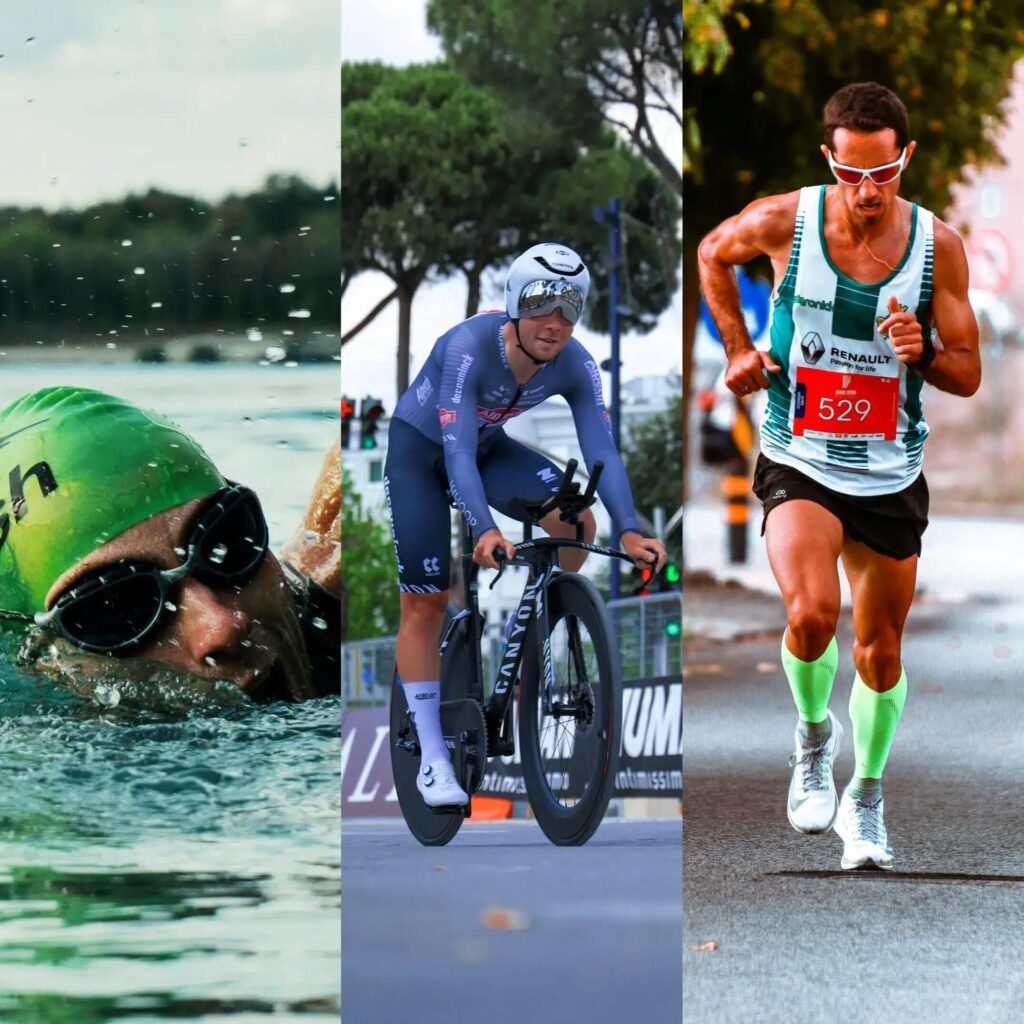
For triathletes, the trap is even easier to fall into because fatigue hides across disciplines. A “controlled” bike on Tuesday can make Wednesday’s run feel flat. A hard swim may not leave your legs sore, but it still taxes your nervous system and recovery budget.
The result is a week full of effort and short on adaptation. You are too tired to go truly hard, but not rested enough to absorb the work.
Efficiency means protecting your hard days
When training time is limited, the instinct is to squeeze more intensity into every available minute. Sometimes that works in the short term. But the better long-term strategy is to protect the sessions that matter most.
This connects with the idea of placing demanding workouts where your life has room, covered in Calendar Periodization. But once those hard sessions are placed, the next step is just as important: keep the surrounding workouts honest.
If Tuesday is your key interval run, Monday should not become a sneaky progression run. If Saturday is your long ride with race-pace blocks, Friday’s swim should not turn into a threshold test. If Thursday is your hard track session, Wednesday’s strength workout should not leave you walking downstairs sideways.
Easy days are not a sign that you lack ambition. They are what allow ambition to show up when it counts.
Use a simple three-bucket system
You do not need a lab test to manage intensity better. Start by sorting your sessions into three buckets.
1. Easy aerobic
This is low-stress work. You should be able to speak in full sentences. On the bike, pressure on the pedals feels light to moderate. In the pool, your stroke stays smooth and repeatable.
Purpose: build aerobic volume, support recovery, improve durability, and keep the habit alive.
2. Quality hard
These are the sessions with a clear performance target: intervals, hill reps, threshold blocks, race-pace work, VO2 max sets, or a long endurance session with structured intensity.
Purpose: create a strong fitness signal.
3. Moderate purposeful
This includes tempo, steady state, marathon pace, sweet spot, or controlled race-specific work. It is useful, but it should be intentional, not accidental.
Purpose: prepare for specific race demands without turning every workout into a grind.
The key rule: moderate is allowed, but it must have a reason.
A practical week for time-crunched athletes
Here is what contrast might look like in real life.
Runner with 4 sessions
- Tuesday: Hard intervals, such as 6 x 3 minutes uphill or at 5K effort
- Thursday: Easy 35 minutes, truly conversational
- Saturday: Long easy run, with optional short strides at the end
- Sunday: Recovery jog or short aerobic run
Cyclist with 3 rides
- Wednesday: VO2 max or threshold intervals
- Friday: Easy spin, high cadence, low pressure
- Sunday: Longer endurance ride with one planned tempo block if appropriate
Triathlete with 6 short sessions
- Monday: Easy swim technique
- Tuesday: Hard bike intervals
- Wednesday: Easy run
- Thursday: Swim with short fast repeats, plenty of rest
- Saturday: Long ride or brick with controlled race-specific work
- Sunday: Easy run or complete rest
Notice what is missing: random medium-hard sessions squeezed between the important ones.
How to tell if your easy is actually easy
Most athletes are worse at this than they think. A few simple checks help.
- Talk test: You should be able to speak in full sentences without needing to pause for breath.
- RPE: Easy should feel like 2–4 out of 10, not 5–6.
- Breathing: Mostly nose breathing or relaxed mouth breathing is a good sign for many athletes.
- Next-day readiness: If every easy day leaves you flat, it was not easy.
- Discipline honesty: An easy swim can still be neurologically tiring. An easy ride can become hard if you chase every hill. An easy run is often harder on the body than it feels in the moment.
If you use heart rate, keep most easy work below your first threshold if you know it. If you do not, use the talk test. It is simple, free, and surprisingly effective.
When short workouts should be hard
This is not an argument against intensity. Short, focused workouts can be powerful. A 35-minute session with a proper warm-up, 10 x 1 minute hard, and a cool-down can move the needle. So can a compact swim set with fast 50s or a bike workout with threshold blocks.
The point is not to avoid hard training. It is to make hard training obvious.
If you are going hard, go hard with a purpose. If you are going easy, go easy enough to recover. If you are going moderate, know exactly why it belongs in the week.
This also pairs well with the idea in Training Density: make the minutes count, but do not confuse density with constant strain. A dense workout can still include recovery, technique, and smart pacing.
A better question before every session
Before you start, ask: What is this workout supposed to make possible?
If the answer is “build aerobic fitness,” keep it easy.
If the answer is “prepare me for race pace,” be controlled and specific.
If the answer is “raise my ceiling,” bring real intensity and protect the recovery around it.
That one question can save a time-crunched athlete from the most common efficiency mistake: training hard enough to get tired, but not clearly enough to get better.
The takeaway
When life is full, every session needs a job. The middle zone is useful when planned, but costly when it becomes the default.
Make your easy days easier. Make your hard days sharper. Use moderate work sparingly and deliberately. That contrast is what lets runners, cyclists, swimmers, and triathletes keep improving without turning limited training time into constant fatigue.
Efficiency is not doing every workout harder. It is doing the right workout at the right effort, then having enough left to come back tomorrow.



Leave a Reply