
Busy days do not have to stop your fitness progress. This guide shows how to build effective workouts when time is tight and how to get strong, burn calories, and keep energy high in short sessions. Read on for clear steps, quick plans, and easy adjustments you can start today.
Why effective workouts can be short
Short workouts work when you focus on what matters. You do not need hours to improve strength and fitness. High quality effort in a small window beats low effort over a long time.
Intensity, movement choice, and consistency drive results. When you choose big movements and keep rests smart, your body gets a clear signal to adapt. That signal builds strength, muscle, and endurance.
Short sessions also lower the barrier to exercise. If training fits your day, you are more likely to repeat the habit. Repeating simple sessions often brings better long-term gains than rare long workouts.
Safety still matters. Warm up, pick manageable loads, and stop if form breaks down. Short workouts should feel productive, not rushed or risky.
Principles of effective workouts
Focus on a few guiding ideas to design effective workouts that fit limited time. Keep choices simple and clear so you can use each minute well. These principles help you train with purpose.
First, pick compound movements. Squats, push patterns, rows, and hinges move many joints and burn more energy. They give the best return on time spent. Use them as the core of each session.
Second, manage work and rest. Short rest and high work density keep heart rate up and build conditioning. For strength, use slightly longer rests but fewer sets. Balance sets, reps, and rest to match your goal.
Third, track progress. Even a short session should follow a plan. Add reps, increase load, or reduce rest over weeks. Small, steady changes create big results over time.
Sample effective workouts (20 to 30 min)
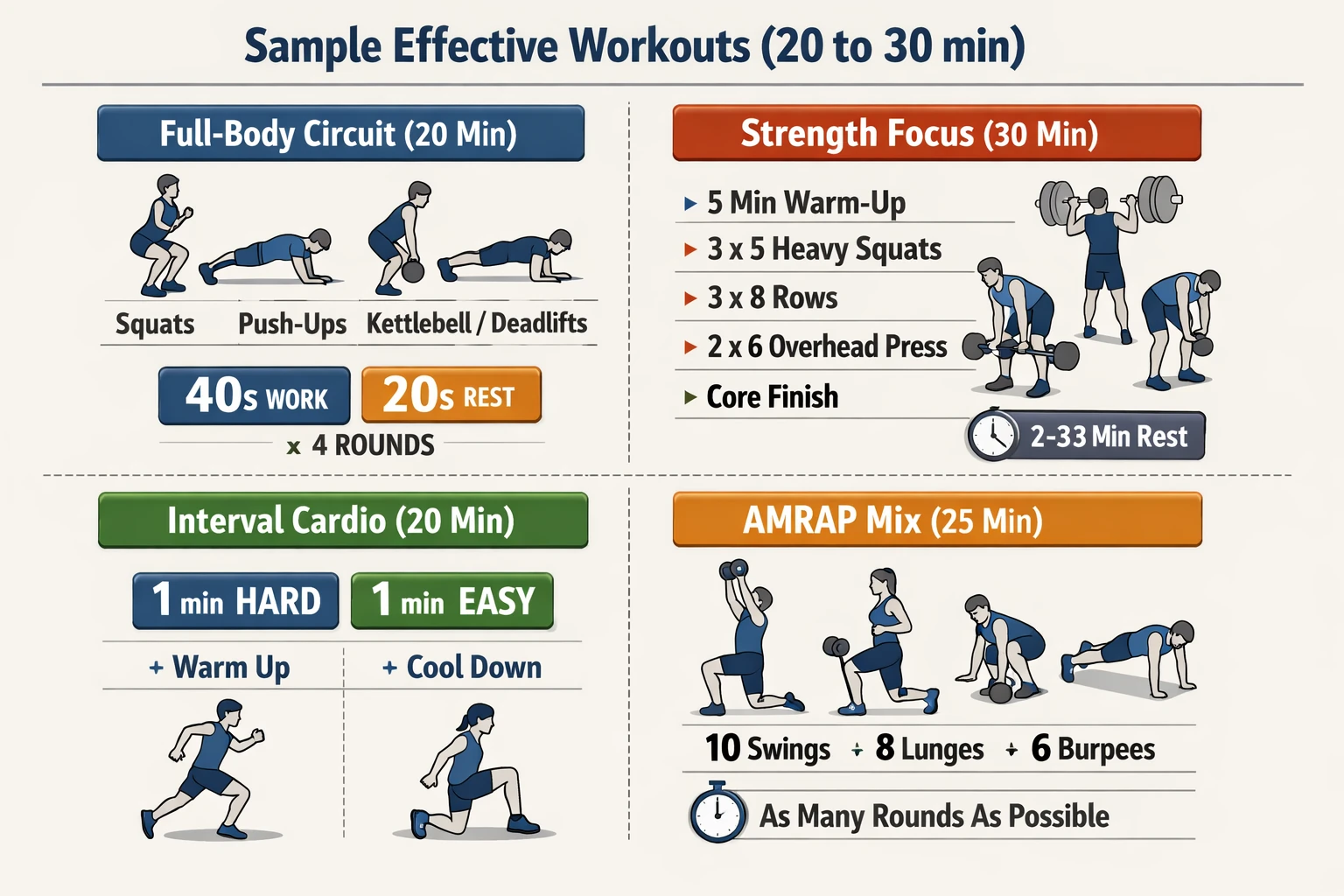
Below are quick, practical routines you can use with minimal equipment. Read the short description to pick the one that matches your goal and fitness level. Each routine fits into 20 to 30 minutes when you set a timer and stick to the plan.
- Full-body circuit (20 minutes): 4 rounds, 40 seconds work, 20 seconds rest. Exercises: squats, push-ups, kettlebell swings or dumbbell deadlifts, plank. Move steadily and keep transitions tight.
- Strength focus (30 minutes): Warm up 5 minutes. 3 sets of 5 heavy squats or deadlifts with 2–3 minutes rest. Then 3 sets of rows and 2 sets of overhead press with 60–90 seconds rest. Finish with a short core set.
- Interval cardio (20 minutes): 5 rounds: 1 minute high effort (run, bike, or jump rope), 1 minute easy. Add a 3-minute warm up and 2-minute cool down. Keep the work intervals hard but controlled.
- AMRAP mix (25 minutes): As many rounds as possible of 10 kettlebell swings, 8 lunges, 6 burpees. Pace so you can keep moving for the full time without stopping long.
These routines are templates. Adjust rep ranges, weights, and interval lengths to match your fitness. If you are new, lower the intensity and add rest. If you want more challenge, increase rounds or reduce rest.
Always end with a brief cool down and light mobility work. A short stretch helps recovery and reduces stiffness. Keep notes on what you did so you can progress the next session.
Maximizing effective workouts in 30 minutes
Plan before you start. Know your exercises, set a timer, and have equipment ready. A simple plan saves time and helps you stay focused. This step is one of the best ways to get consistent results.
A clear title or checklist can help. For example: How To Maximize Your Training In Under 30 Minutes. Use that idea as a short checklist: warm up, main work block, short finish, cool down. Stick to the clock and avoid distractions.
Use supersetting and circuits to cut idle time. Supersets pair two exercises so you work different muscles while resting one set. Circuits keep your heart rate up and give a big conditioning benefit in little time.
Prioritize intensity and form. Short sessions require high focus. Move with full attention and choose a load that challenges you for the planned reps. Track progress by adding small load increases or a few more reps each week.
Let’s Recap
Effective workouts do not need long hours. Focus on compound moves, smart rest, and steady progress. A 20 to 30 minute session can improve strength, fitness, and mood if you train with purpose.
Use the sample routines as a starting point and adjust them to match your level. Keep sessions simple and consistent. Small gains add up when you repeat them week after week.
Start today with one focused session. Set a timer, pick a plan, and commit to being consistent. Over time you will see real progress without spending hours at the gym. Enjoy the process and celebrate small wins!